
Why Long-Route Carpooling is Your Ultimate Choice A Comprehensive Guide to Savings, Safety & Comfort
February 26, 2026
Car Lift vs Taxi in Dubai Which Commute Option Is Best?
March 4, 2026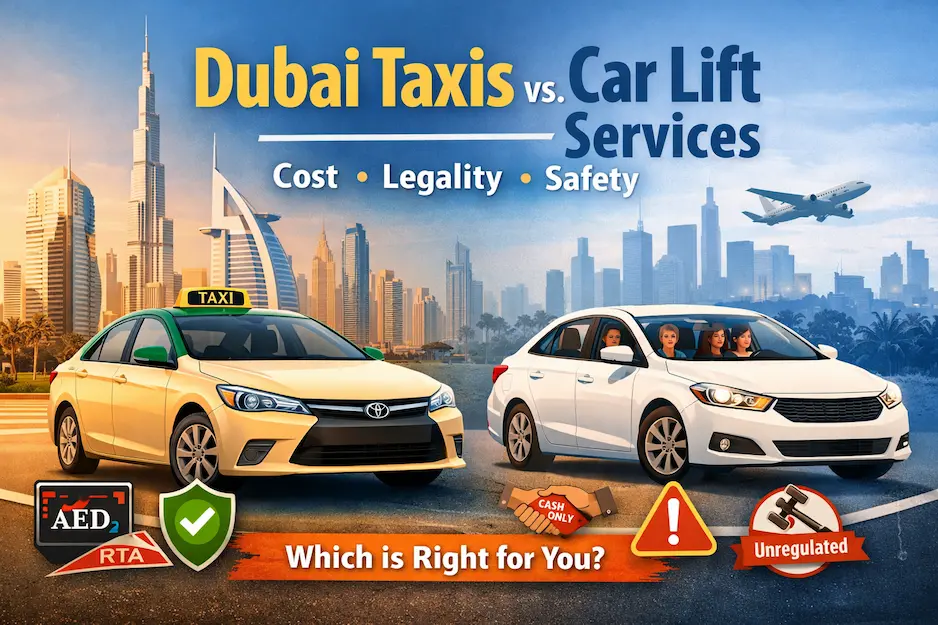
Introduction
Dubai moves fast. Whether you’re commuting between Business Bay and JLT, heading to the airport from Marina, or navigating Deira during peak hours, transportation isn’t just about getting from point A to B — it’s about reliability, legality, and peace of mind. Yet many residents and visitors still hesitate when choosing between official RTA taxis and informal “car lift” services.
The confusion is understandable. Car lifts often advertise lower prices or flexible arrangements through WhatsApp groups and community networks. At the same time, official taxis regulated by Dubai’s Roads and Transport Authority (RTA) operate with metered fares, visible licensing, and standardized oversight. The difference in structure raises important questions:
- Are car lifts legal?
- Why are some fares significantly cheaper?
- What happens if there’s an accident or dispute?
- Which option truly offers better value for regular commuting?
These are not minor concerns. Inconsistent pricing, unclear liability, and regulatory violations can lead to fines, delays, or serious safety risks. For professionals commuting daily, families traveling at night, or business travelers requiring accountability, the wrong choice can cost more than money — it can cost security and legal protection.
This guide provides a clear, practical comparison between official RTA taxis and car lift services in Dubai. We will examine:
- Legal status and regulatory framework
- Cost structure and hidden risks
- Safety standards and insurance coverage
- Convenience, availability, and service consistency
By the end, you will have the clarity needed to choose confidently — based not on assumptions or hearsay, but on legal facts, financial transparency, and real-world practicality within Dubai’s transportation ecosystem.
What Are Official Taxis in Dubai?
When reliability, legal clarity, and accountability matter, official taxis regulated by Dubai’s transport authority remain the benchmark. While alternative transport options exist, official taxis operate within a clearly defined legal and operational framework — and that distinction is critical.
RTA Regulation and Oversight
Roads and Transport Authority
Official taxis in Dubai operate under strict regulatory control by the Roads and Transport Authority (RTA). This oversight ensures uniform service standards across all licensed taxi operators in the emirate.
What Regulation Covers
Licensing & Franchise Control
- Taxi companies operate under RTA-issued permits.
- Fleet sizes, vehicle age limits, and operational standards are monitored.
- Common operators include Dubai Taxi Corporation (DTC) and other licensed franchise partners.
Driver Qualifications
- Mandatory background checks.
- Professional driving certification.
- Customer service training.
- Knowledge of Dubai routes and safety protocols.
Vehicle Standards & Inspections
- Regular mechanical inspections.
- Mandatory insurance coverage.
- Vehicle age restrictions to maintain fleet quality.
- Installation of approved digital taxi meters.
You can verify official regulations, licensing standards, and tariff structures directly through the RTA’s official website, which publishes transport laws and service standards.
Why This Matters
Government-backed regulation ensures:
- Legal protection for passengers
- Accountability in case of disputes
- Structured complaint resolution
- Standardized service quality
In practical terms, this means you are not just hiring a car — you are using a monitored public transport service.
Metered Fares and Transparency
One of the strongest advantages of official taxis is fare transparency.
How the Meter Works
Fares are calculated through an RTA-calibrated digital meter that includes:
- Flag fall (starting charge) when the trip begins
- Per-kilometer rate
- Waiting time charge (when vehicle is stationary)
The fare increases in real time and is visible to passengers throughout the journey.
Key Transparency Benefits
- Pricing is standardized and non-negotiable
- No hidden charges
- Receipts available (printed or digital)
- Clear dispute mechanism if discrepancies arise
Potential Surcharges
Passengers should be aware of regulated additional charges such as:
- Airport pickup surcharge
- Advance booking fee
- Late-night tariff adjustments
- Special vehicle category pricing (e.g., larger taxis)
All surcharges are officially published and regulated.
Expert Tip
For maximum transparency and tracking, use the official booking platforms:
S’hail App
DubaiNow
These apps provide:
- Real-time vehicle tracking
- Fare estimation
- Digital payment options
- Trip history and receipts
Understanding “Car Lift” Services in Dubai
If official taxis represent structure and regulation, “car lift” services sit on the opposite end of the spectrum — informal, flexible, and often misunderstood. Many residents hear about them through colleagues, community groups, or WhatsApp broadcasts. But what exactly are they, and where do they stand legally?
Let’s separate perception from reality.
Defining “Car Lift”: Perceptions vs. Reality
In everyday usage, a “car lift” typically refers to a private vehicle offering paid rides outside the official taxi and licensed ride-hailing system.
Unlike RTA taxis, these services do not operate under the oversight of the Roads and Transport Authority. They function independently — and that distinction carries significant implications.
How They Typically Operate
- Arranged through word-of-mouth
- Coordinated via WhatsApp groups or Facebook communities
- Booked through informal private networks
- Drivers usually use personal vehicles, not commercial fleet cars
There is no standardized booking platform, no central dispatch system, and no official regulatory monitoring.
Perception vs. Reality
Common Perception
- Cheaper than taxis
- Flexible pickup and drop-off
- Easier for fixed daily commuting
- More convenient for inter-emirate travel
Practical Reality
- Unregulated operations
- No standardized pricing system
- No official passenger insurance guarantee
- Varying reliability
- Potential legal consequences
The lower cost often comes from avoiding licensing fees, commercial permits, and regulatory compliance — not from operational efficiency.
That distinction matters.
Operational Models and Common Practices
Car lift services typically fall into two broad categories:
1️⃣ Shared Car Lifts
- Fixed routes (e.g., Sharjah–Dubai, Ajman–Dubai)
- Multiple passengers
- Pre-arranged daily schedules
- Common among office commuters
These resemble informal shuttle systems but operate without government authorization.
2️⃣ Private Car Lifts
- Direct, point-to-point service
- Individually negotiated pricing
- No meter system
- Often used for airport transfers or late-night travel
Payment Structure
Unlike metered taxis:
- Payment is usually cash
- Sometimes via bank transfer
- Rarely digital receipts
- No standardized fare breakdown
This lack of transparency increases the risk of disputes, inconsistent charges, or sudden price adjustments.
The Grey Areas: What You Need to Know
Here’s where many residents become uncertain.
1️⃣ Unregulated Nature
Car lift services are not licensed as commercial passenger transport providers. They are not supervised by RTA taxi regulations and do not follow standardized safety audits.
This means:
- No official fare structure
- No government-approved insurance coverage for passengers
- No formal complaint resolution system
2️⃣ Lack of Standardization
There is no requirement for:
- Driver background checks
- Vehicle inspection schedules
- Commercial insurance classification
- Meter calibration
- Service quality benchmarks
Every driver operates independently, which creates inconsistency.
The confusion often stems from the assumption that if a service is widely used, it must be allowed. However, in Dubai, passenger transport for hire is regulated. Offering paid rides without proper licensing can expose drivers — and in some cases passengers — to legal consequences.
Authorities have conducted periodic crackdowns on unauthorized passenger transport, reinforcing that commercial transport requires official permits.
Practical Takeaway
Car lift services may appear attractive for:
- Lower upfront cost
- Fixed daily commuting arrangements
- Familiar community-based networks
However, the trade-off includes:
- Legal uncertainty
- Lack of passenger protection
- No standardized safety enforcement
- Potential disruption during enforcement campaigns
For residents prioritizing regulatory compliance, insurance protection, and dispute accountability, these grey areas become critical decision factors.
The Head-to-Head: Official Taxi vs. Car Lift (Comprehensive Comparison)
When choosing transport in Dubai, the difference isn’t just about price — it’s about legal standing, accountability, and risk exposure. Below is a structured, practical comparison between official RTA taxis and informal car lift services.
Important Clarification:
The “Car Lift Service” column refers to informal, unlicensed private vehicle services. It does not include regulated ride-hailing platforms such as Uber or Careem, which operate under Dubai’s transport regulations and licensing frameworks.
Direct Comparison
| Criteria | Official Taxi | Car Lift Service (Informal) |
|---|---|---|
| Legality & Regulation | Fully regulated and licensed under the Roads and Transport Authority. | Often operates in a legal grey area. May be considered illegal if transporting passengers for profit without proper licensing. |
| Pricing Model | Metered, standardized RTA-approved tariffs. Transparent and non-negotiable. | Negotiated or fixed fares. Can vary widely depending on route, driver, or demand. |
| Safety & Assurance | Drivers vetted, vehicles inspected, commercial insurance mandatory. Formal complaint system available. | Driver vetting, vehicle safety, and insurance coverage may be unclear. Limited formal dispute resolution. |
| Availability | 24/7 across Dubai. Easily hailed or booked via official apps. | Dependent on driver availability. Often requires pre-arrangement. Less suitable for spontaneous travel. |
| Comfort & Vehicle Standards | Vehicles must meet RTA age, maintenance, and inspection standards. | Highly variable. No standardized inspection or maintenance oversight. |
| Booking & Convenience | Book via S’hail App, taxi stands, or street hailing. Quick and structured. | Typically arranged via WhatsApp groups, social media, or direct contact. Requires advance coordination. |
| Flexibility | Door-to-door within RTA-permitted zones. No fixed route restrictions. | Shared lifts often follow fixed routes. Limited flexibility for detours or sudden changes. |
| Accountability | Clear complaint channels under RTA oversight. Passenger protections defined. | Minimal formal accountability. Disputes resolved privately, if at all. |
| Payment Options | Cash, card, digital app payments. Official receipts available. | Usually cash. Sometimes bank transfer. Rarely formal receipts. |
| Transparency | High. Meter displays fare in real time. Official tariff structure publicly available. | Low. Pricing agreed verbally. No standardized documentation. |
Strategic Insight: When Each Option Might Make Sense
Official Taxi Is More Suitable If You:
- Prioritize legality and insurance protection
- Need on-demand availability
- Require digital payment and receipts
- Want government oversight and complaint channels
Car Lift May Appeal If You:
- Have a fixed daily commute
- Are operating within a trusted private network
- Accept variability in pricing and legal exposure
The Core Trade-Off
The comparison ultimately comes down to this:
- Official taxis offer structure, regulation, and protection.
- Car lifts offer flexibility and potential cost savings — but with uncertainty.
For many residents in Dubai, the decision isn’t about convenience alone. It’s about how much legal clarity, safety assurance, and accountability you’re willing to trade for lower upfront cost.
Navigating the Legal Landscape: Regulations & Compliance
Dubai’s transport ecosystem looks flexible on the surface, but legally it’s quite structured: paid passenger transport is regulated, and the protections you get (insurance, enforcement standards, complaint routes) depend heavily on whether the service is licensed.
RTA Regulations for Taxis
Official taxis in Dubai are part of a regulated public transport service overseen by the Roads and Transport Authority (RTA). Practically, that regulation shows up in three ways: how fares are calculated, how taxis are booked/operated, and what standards apply to the service.
1) Fare rules are defined and published
RTA publishes how taxi fare is calculated (base fare + distance + waiting time + specific add-ons like Salik and certain zone/entry fees). That’s the legal foundation for “metered and transparent,” because it ties the fare to a known calculation—not negotiation.
RTA service information also specifies standard components like waiting time charges and peak-hour definitions in its taxi service details.
2) Booking channels are official and traceable
RTA promotes booking taxis through official/partner channels such as the S’hail app—and also explicitly references booking through Careem for RTA taxis (e.g., Hala).
This matters legally because it creates trip traceability (booking record, pickup metadata, and a platform to escalate issues).
3) Vehicles and operations are tied to compliance checks
Across RTA services, compliance is enforced through things like insurance validity checks and technical inspection requirements in vehicle-related processes (these are foundational controls used across transport regulation).
Bottom line: with official taxis, the legal framework is visible: published fare methodology + regulated channels + compliance mechanisms.
The Legal Status of Car Lifts
The core legal issue
When people say “car lift” in Dubai, they usually mean a private vehicle transporting passengers for money outside a licensed operator framework. The legal risk isn’t “sharing a ride with a friend.” It’s transporting passengers for a fee without the required permits/authorizations.
RTA has publicly conducted inspection campaigns targeting unlicensed passenger transport, issuing violations and seizing vehicles—showing this is an active enforcement area, not a theoretical rule.
Crucial distinction: informal car lifts vs regulated ride-hailing (Careem/Uber)
- Informal car lifts = typically arranged via WhatsApp/communities, personal cars, negotiated cash fares, and no visible licensing framework.
- Regulated e-hailing / limousine services = operate through approved structures and must meet RTA requirements.
For example, Uber’s Dubai driver/vehicle requirements explicitly reference RTA-approved limousine documentation and RTA-related compliance requirements.
And RTA itself promotes booking taxis via S’hail and also via Careem as an official pathway for taxi booking (i.e., regulated and integrated into the ecosystem).
Penalties and Risks of Non-Compliance
For drivers (high enforcement exposure)
RTA’s own enforcement communication confirms inspections resulted in violations and vehicle seizures for unlicensed passenger transport.
Legal reporting referencing Dubai’s regulatory decisions notes fines can reach up to AED 30,000 for individuals and AED 50,000 for companies for illegal passenger transport (and these inspections often involve multi-agency enforcement).
For passengers (less “legal penalty,” more “practical harm”)
Passengers typically face fewer direct legal consequences than drivers, but they absorb the real risk in three common ways:
- Insurance uncertainty: if the trip is “commercial” in practice but the vehicle/coverage isn’t structured for paid passenger transport, claims can get complicated.
- Safety & standards gaps: no standardized inspections/vetting like regulated services.
- Limited recourse: no clear regulator-led complaint process or documented fare/meter record.
Cost Deep Dive: Which Option Is Truly Cheaper?
Price is where most decisions begin — and often where confusion starts.
At first glance, informal car lifts appear cheaper. But once you factor in official fare structures, peak pricing, airport surcharges, and route distance, the comparison becomes more nuanced.
Below is a structured breakdown of how costs are calculated — and where the real differences lie.
Taxi Fare Structure Explained
Official taxis in Dubai operate under tariffs set and published by the
Roads and Transport Authority.
Fare estimates below are based on publicly available RTA tariff components and commonly observed 2024–2025 rate structures. (Always verify current rates directly through RTA or the S’hail App for real-time pricing.)
Core Fare Components
1️⃣ Flag Fall (Starting Fare)
- Standard city start: approx. AED 12
- Airport start: approx. AED 25
2️⃣ Per-Kilometer Rate
- Roughly AED 2.0–2.3 per km (varies slightly depending on conditions)
3️⃣ Waiting Charges
- Applied when vehicle is stationary in traffic
4️⃣ Additional Charges
- Airport surcharge
- Salik (toll) charges
- Advance booking fee (if applicable)
Important: Peak & Dynamic Pricing
- Late-night and peak-hour adjustments may apply.
- Ride-hailing platforms (e.g., Careem or Uber) may implement surge pricing during high demand.
Car Lift Pricing Models
Unlike taxis, car lift pricing has no standardized framework.
Common Pricing Structures
Negotiated Fare
- Price agreed verbally before trip
- No meter or official tariff
Fixed Route Rate
- Daily commuter packages (e.g., Sharjah–Dubai)
- Monthly subscription-style arrangements
Factors That Influence Price
- Distance
- Traffic conditions
- Time of day
- Number of passengers (shared vs private)
- Driver discretion
- Frequency of travel
Because pricing is informal, two passengers on the same route may pay different amounts.
Illustrative Route Comparisons
To provide realistic comparisons, the following estimates use:
- Approximate route distance (Google Maps averages)
- RTA starting fare + estimated per-km rate
- No extreme traffic scenario included
These are illustrative examples for analysis purposes.
Differentiation Idea: Interactive Cost & Time Estimator
An ideal decision tool would allow users to:
- Enter route distance
- Select peak or off-peak
- Choose shared vs private
- Compare:
- Estimated taxi fare
- Estimated ride-hailing fare
- Estimated car lift range
Such a calculator could provide scenario-based transparency rather than relying on general assumptions.
Safety, Trust, and Accountability
Cost matters. Convenience matters. But when something goes wrong — an accident, a dispute, or even a lost item — safety systems and accountability structures become the deciding factors.
In Dubai, the difference between official taxis and informal car lift services is most visible in how risk is managed.
Structured Safety & Accountability Comparison
| Factor | Official Taxi | Car Lift (Informal) |
|---|---|---|
| Driver Background Checks | Mandatory | Not standardized |
| Professional Licensing | Required | Typically none |
| Vehicle Inspections | Scheduled & regulated | No mandatory commercial inspection |
| Commercial Insurance | Yes | Often unclear |
| Complaint Mechanism | RTA complaint channels & app | Informal, driver-dependent |
| Trip Tracking | App-based tracking available | Rarely documented |
Complaint Resolution and Recourse
Official Taxi
Passengers can file complaints via:
- RTA customer service
- S’hail App
- Taxi company support lines
Each taxi has a visible identification number, making traceability straightforward.
Car Lift
Disputes are typically resolved:
- Directly with the driver
- Through community mediators
- Or not at all
There is no structured regulatory escalation pathway.
Convenience, Flexibility, and Availability
Booking Ease & Wait Times
Official Taxis
- Street hailing
- Taxi stands
- App booking
- Short average wait times in central areas
Car Lifts
- Must be pre-arranged
- Dependent on driver availability
- May require coordination across multiple contacts
Spontaneous trips strongly favor official taxis.
Route Flexibility
Official Taxi
- Door-to-door
- Passenger can request preferred route
- No fixed-route restrictions
Shared Car Lift
- Usually fixed route
- Limited detour flexibility
Private Car Lift
- More flexible, but higher negotiated fare
24/7 Availability
Official taxis operate around the clock across Dubai.
Car lift availability depends entirely on:
- Driver schedule
- Demand
- Existing route commitments
Real-World User Experiences
These anonymized examples reflect common patterns among Dubai residents:
Taxi Experience (Positive Accountability)
“I once left my phone in an RTA taxi. Because the trip was logged, customer service tracked the driver, and I recovered it the same day.”
Car Lift Experience (Cost Efficiency)
“For my daily Sharjah–Dubai commute, a shared lift saves me thousands per month. I know the driver personally, and it works well for a fixed routine.”
These stories illustrate the core trade-off:
- Structure and protection vs.
- Cost savings and familiarity
Integrating Public Transport for Smarter Travel
For many residents, the smartest approach is hybrid.
Combine:
- Metro for main corridors
- Bus for extended routes
- Taxi for last-mile travel
Route planning apps such as
Google Maps and Waze
allow integrated transport planning — often reducing overall cost without sacrificing legality.
The Practical Bottom Line
If your priority is:
- Insurance protection
- Legal clarity
- Reliable complaint channels
- Structured accountability
Official taxis provide a controlled, regulated environment.
If your priority is:
- Cost savings on fixed daily routes
- Familiar, community-based arrangements
Car lifts may work — but only with full awareness of the trade-offs.
Pros and Cons: Official Taxis in Dubai
Choosing an official taxi in Dubai means choosing a regulated system. That structure brings predictability — but also defined costs.
✅ Advantages of Official Taxis
1️⃣ Legality and Safety
Operates under the supervision of the
Roads and Transport Authority.
Vehicles are licensed, insured, and drivers are vetted.
2️⃣ Transparency
- Metered fare structure
- Published tariff system
- Digital receipt options
- No negotiation or hidden pricing
3️⃣ Reliability
- 24/7 operation
- Professional drivers
- City-wide coverage
4️⃣ Ease of Access
- Street hailing
- Taxi stands at malls, hotels, airports
- App booking via S’hail App
5️⃣ Clear Recourse
Complaint channels exist through RTA and taxi operators. Every vehicle has an ID number, making traceability straightforward.
Expert Insight:
For tourists, business travelers, or anyone prioritizing legal clarity and documentation, official taxis remain the most straightforward and dependable option.
❌ Disadvantages of Official Taxis
1️⃣ Higher Cost for Long Routes
Particularly for inter-emirate travel, metered pricing can add up quickly compared to shared alternatives.
2️⃣ Peak Hour Adjustments
Airport surcharges, night tariffs, and booking fees can increase the final fare.
3️⃣ Traffic Impact
Because pricing is distance- and time-based, heavy congestion increases total cost.
Pros and Cons: Opting for a Car Lift Service
Car lift services attract commuters primarily because of price flexibility — but that flexibility comes with trade-offs.
✅ Advantages of Car Lift Services
1️⃣ Cost Savings
Shared lifts can be significantly cheaper, especially for daily long-distance commuting (e.g., Sharjah–Dubai routes).
2️⃣ Negotiated Flexibility
Private arrangements may allow:
- Custom pickup points
- Adjusted schedules
- Fixed monthly rates
3️⃣ Community Aspect
Regular shared commuters often build familiarity with drivers and fellow passengers, creating a routine-based comfort level.
❌ Disadvantages of Car Lift Services
1️⃣ Legal Uncertainty
Paid passenger transport without proper licensing can fall into a regulatory grey area. Enforcement campaigns have targeted unlicensed operations.
2️⃣ Safety & Accountability Concerns
- No standardized driver vetting
- No mandatory vehicle inspection system for commercial use
- Limited formal complaint mechanism
3️⃣ Reliability Variability
Service depends entirely on individual drivers. Delays, cancellations, or route changes may occur.
4️⃣ Limited Spontaneity
Requires pre-arrangement. Not ideal for last-minute trips.
5️⃣ Pricing Transparency Issues
- Verbal fare agreements
- No official meter
- Rarely formal receipts
Practical Tip:
Always confirm the destination and final fare before starting any non-metered journey. Clarify whether tolls or additional stops are included.
The Core Trade-Off
| If You Value… | Best Fit |
|---|---|
| Legal protection & insurance clarity | Official Taxi |
| Predictable fare structure | Official Taxi |
| Lower monthly commuting cost | Shared Car Lift |
| Flexible negotiated routine | Private Car Lift |
| Immediate on-demand ride | Official Taxi |
Scenario-Based Recommendation Matrix
| Scenario | Official Taxi | Car Lift (Informal) | Regulated Ride-Hailing (Careem/Uber) |
|---|---|---|---|
| Budget is Top Priority | Not ideal for long distances. | Best (especially shared fixed routes). | Good (promotions, economy tiers). |
| Urgency & Speed | Best (readily available, direct). | May require coordination. | Very Good (quick app booking). |
| Safety & Assurance | Best (regulated, insured, accountable). | Not recommended (no standardized oversight). | Good (driver vetting, tracking, in-app support). |
| Airport Transfers | Best (designated airport zones, regulated). | Not recommended (legal & reliability risks). | Good (pre-booking, clear fare estimate). |
| Daily Commutes | Can be expensive long-term. | Best (shared routes, negotiated monthly rates). | Good (subscription models, economy tiers). |
| Late Night Travel | Best (24/7 regulated service). | Risky, availability uncertain. | Very Good (24/7, trip tracking). |
| Group Travel | Good (larger taxi vehicles available). | Good if trusted and pre-arranged. | Very Good (SUV/XL options). |
| New to Dubai / Tourist | Best (straightforward, official system). | Not recommended (complex, uncertain). | Good (familiar app interface). |
| Environmental Concern | Mixed (individual rides). | Potentially better if shared. | Good (carpool/eco options in some tiers). |
Practical Scenario Guidance
Budget-Conscious Travel
If cost is your primary concern:
- Shared car lifts offer the lowest per-person cost, especially for Sharjah–Dubai or Ajman–Dubai commutes.
- Regulated ride-hailing economy tiers may offer competitive alternatives during off-peak hours.
Smarter Hybrid Strategy:
Use Dubai Metro or bus for the majority of your route, then take a short taxi ride for last-mile connectivity. This often reduces total spend while maintaining legality.
Urgent Travel & Time Sensitivity
When speed matters:
- Official taxis can be hailed immediately in most urban areas.
- Ride-hailing apps provide real-time driver tracking and predictable ETAs.
Car lifts are rarely suitable for urgent trips due to coordination delays.
Airport Transfers
For airport travel:
- Official taxis have designated pickup zones and regulated airport starting fares.
- Ride-hailing services allow pre-booking and digital payment confirmation.
Informal car lifts are not recommended due to:
- Legal exposure
- Potential access restrictions
- Uncertain reliability during early/late flights
Expert Tip:
Always verify pickup location rules at Dubai International Airport (DXB) or Al Maktoum International to avoid confusion.
Daily Commutes
For routine commuters:
- Shared car lifts can significantly reduce monthly costs.
- Establishing a consistent arrangement improves reliability.
However:
Weigh savings against:
- Legal uncertainty
- Insurance clarity
- Service disruption risk
Some professionals choose a balanced model:
- Car lift for weekday commute
- Taxi or ride-hailing for weekend and late-night travel
Group Travel
Options vary depending on group size:
- Official taxis offer larger vehicle variants.
- Ride-hailing apps provide XL or SUV options.
- Private car lifts may work if arranged with trusted drivers — but verify safety and insurance considerations.
Late Night & Off-Peak Travel
This is where regulation matters most.
Official taxis provide:
- 24/7 availability
- Visible driver identification
- Clear complaint recourse
Ride-hailing platforms offer similar benefits with trip tracking and app-based safety tools.
Informal lifts at night carry higher uncertainty due to:
- Limited availability
- Lack of structured monitoring
Final Decision Framework
If your top priority is:
- Legal protection
- Insurance clarity
- Structured accountability
- On-demand flexibility
→ Official Taxi
If your priority is:
- Lowest commuting cost
- Fixed daily routes
- Familiar trusted arrangements
→ Shared Car Lift (with full awareness of risks)
If you want:
- App-based convenience
- Clear pricing estimate
- Good balance between regulation and flexibility
→ Regulated Ride-Hailing
The Bottom Line
There is no universally “best” option — only the best option for a specific situation.
The smartest approach in Dubai often isn’t choosing one system exclusively — but understanding when each makes practical, legal, and financial sense.
Addressing Your Top Questions (FAQs)
❓ Is it illegal to use a car lift service in Dubai?
Transporting passengers for profit without proper licensing falls outside Dubai’s regulated transport framework under the
Roads and Transport Authority.
For drivers, this can lead to fines, vehicle impoundment, and legal consequences.
For passengers, the risk is less about fines and more about:
- Lack of regulated insurance coverage
- No formal complaint mechanism
- Service disruption during enforcement campaigns
In short: informal car lifts operate in a legal grey area, while licensed taxis and regulated ride-hailing services operate within approved frameworks.
How do I report an issue with a taxi or a car lift?
For Official Taxis:
- File a complaint via the S’hail App
- Contact RTA customer service
- Provide the taxi number and trip details
Because taxis are regulated, there is a structured escalation process.
For Car Lifts:
- No formal complaint channel exists
- Resolution depends on the individual driver
- Illegal transport activity may be reported to authorities
The key difference is accountability infrastructure.
What payment methods are accepted?
Official Taxis:
- Cash
- Credit/debit card
- App payments
Regulated Ride-Hailing (e.g., Careem/Uber):
- In-app payment
- Digital receipts
- Card or wallet options
Car Lifts:
- Primarily cash
- Occasionally bank transfer
- Rarely documented receipts
Environmental Footprint Comparison
Sustainability is becoming a growing consideration in Dubai’s transport ecosystem.
Official Taxis
Dubai has gradually expanded its fleet of hybrid and low-emission taxis under RTA initiatives. Hybrid vehicles reduce fuel consumption and emissions compared to older models.
However, most taxi rides are single-occupancy.
Conclusion: Making Your Informed Transport Choice in Dubai
Dubai offers a diverse, evolving transport landscape. The key is not choosing what’s cheapest by default — but choosing what fits your priorities.
Key Takeaways
Official Taxis
- Strongest in legality, insurance, and accountability
- Ideal for tourists, airport transfers, urgent travel
- More expensive for long daily commutes
Car Lifts (Informal)
- Cost-effective for shared, fixed daily routes
- Legal uncertainty
- Limited safety oversight
- Minimal complaint recourse
Regulated Ride-Hailing
- Balanced option
- App convenience
- Transparent pricing
- Regulated framework
Empowering Your Decision
When deciding, ask yourself:
- Is budget my primary driver?
- Is legal certainty non-negotiable?
- Do I need immediate availability?
- Am I commuting daily on a fixed route?
- How important is insurance coverage and complaint recourse?
Balancing cost with safety and compliance leads to smarter long-term decisions.
Interactive Concept: “Which Dubai Transport Is Right for You?”
Sample Flow Logic (Text Version)
1️⃣ Is legality and insurance your top priority?
→ Yes → Official Taxi
→ No → Continue
2️⃣ Is budget your primary concern for daily commuting?
→ Yes → Shared Car Lift
→ No → Continue
3️⃣ Do you want app-based booking and tracking?
→ Yes → Regulated Ride-Hailing
→ No → Official Taxi
This visual flowchart can help readers quickly determine their best option based on personal priorities.
Commitment to Accuracy & Updates
Transport regulations, fare structures, and service models evolve. This guide is based on current publicly available information and regulatory frameworks.
We commit to reviewing and updating this content periodically to reflect:
- Changes in RTA policies
- Fare adjustments
- New safety regulations
- Updates in ride-hailing frameworks
Staying informed ensures your transport decisions remain both smart and compliant.
Final Thought
Dubai’s transport system offers flexibility — but clarity matters.
Choose not just the cheapest ride — choose the one that aligns with your budget, schedule, safety expectations, and legal comfort level.