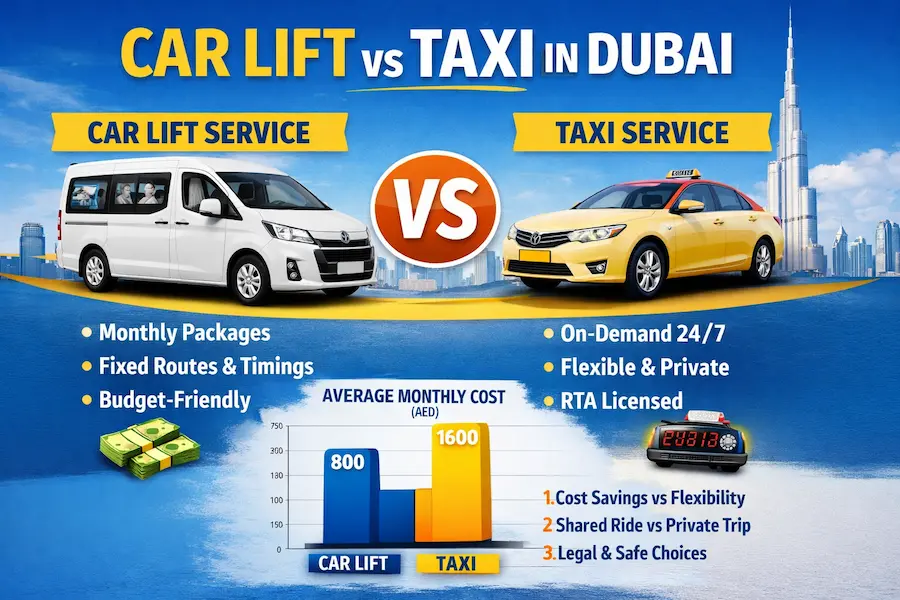
Car Lift vs Taxi in Dubai: Which Commute Option Actually Works?
This comparison comes up every time someone new to Dubai starts pricing out their daily commute. The surface-level answer is simple: taxis cost more per trip, car lifts cost less per month. But the more useful answer requires knowing what kind of journey you are actually making, because the two options are not interchangeable and are not really competing for the same customer in most cases.
This guide works through the real variables: fare structures with actual numbers, the RTA regulatory distinction between licensed and unlicensed services, the geographic limitations of each option, and the specific journey types where one clearly outperforms the other.
How Each Option Actually Operates
Taxis in Dubai
Dubai’s taxi network is operated and regulated by the Roads and Transport Authority (RTA). The Dubai Taxi Corporation (DTC) manages the licensed fleet, with additional operators including Cars Taxi, National Taxi, Metro Taxi, and Arabia Taxi operating under RTA authorisation. All metered taxis in Dubai use the same RTA fare structure regardless of which operator supplies the vehicle.
Base fare on booking (via app or phone): AED 5.00. Base fare on street hail: AED 4.00. The per-kilometre rate after the initial distance is AED 1.96. Waiting time charges apply at AED 0.50 per minute when the vehicle is stationary. A minimum fare of AED 12 applies to all trips. The airport pickup surcharge from Dubai International Airport (DXB) is AED 25, added to the metered total. Late-night supplement (01:00 to 06:00, Friday to Sunday) is AED 2.00.
Ride-hailing platforms operating in Dubai include Careem, Uber, and Hala. Hala is the RTA’s official app-based dispatch system, operating through the Careem platform and dispatching licensed RTA taxis at upfront prices without surge pricing. Careem and Uber also operate independently with privately contracted vehicles, applying dynamic surge pricing during peak demand windows (typically 07:30 to 09:30 and 17:00 to 19:30 on weekdays).
Taxis operate 24 hours a day, seven days a week, across all areas of Dubai and can travel between emirates. There are no route restrictions on destination.
Car Lift Services in Dubai
A car lift service in Dubai is a pre-arranged, fixed-route shared transport arrangement. A driver operating on a set corridor carries one to three passengers at an agreed fare per seat. The service is scheduled in advance, usually on a daily, weekly, or monthly basis. It is not on-demand: you book a seat on a specific departure, not a vehicle to an address of your choice.
Car lift services are most prevalent on the high-volume intercity corridors: Dubai to Sharjah, Dubai to Ajman, and Dubai to Abu Dhabi. Within Dubai, they are less common because the intra-city taxi and Metro network is dense enough that the shared-cost advantage narrows.
The legal distinction that matters: Any commercial passenger transport service in Dubai requires a licence from the RTA. This includes car lift services. Informal arrangements advertised through WhatsApp groups, Facebook communities, or classifieds boards are typically operated without commercial transport licences, without commercial passenger insurance, and without driver background verification through an official framework. The RTA and Dubai Police actively enforce against unlicensed passenger transport, and drivers operating illegally face fines and vehicle confiscation. For passengers, an accident involving an unlicensed vehicle creates significant complications on insurance claims because no commercial cover exists.
Licensed car lift providers operate under RTA-approved frameworks, carry commercial passenger insurance, and use drivers with appropriate licence classifications. MB Car Lift operates on this basis. The distinction is not a formality.
Fare Comparison: What the Numbers Actually Look Like
Short Intra-City Trip (5 to 8 km, e.g. Business Bay to DIFC)
A 6 km trip with no significant waiting time: base fare AED 5, distance AED 11.76, approximate total AED 17 to 20. On Hala (upfront pricing), similar. On surge-priced Careem or Uber during morning peak, AED 22 to 30.
Car lift for a 6 km trip: this is not a realistic car lift use case. Car lifts operate on fixed intercity or cross-district corridors, not short on-demand city hops. For a 6 km trip, your options are taxi, Metro, or ride-hailing.
Medium Intra-City Trip (20 to 25 km, e.g. Al Quoz to Dubai Marina)
Metered taxi: AED 43 to 52 depending on waiting time. Hala upfront: approximately AED 38 to 45. Surge ride-hail during peak: AED 55 to 75.
Car lift: if this specific route is covered by a licensed provider with a regular corridor, AED 20 to 30 per seat. Monthly arrangement at five days per week, return: approximately AED 800 to 1,200 per month vs AED 1,500 to 2,000 for equivalent taxi use.
Inter-Emirate Trip (Dubai to Sharjah)
The Dubai to Sharjah corridor runs approximately 25 to 35 km depending on origin and destination zones. Metered taxi: AED 60 to 100 one way depending on traffic, Salik tolls, and waiting time. On Careem or Uber with surge: AED 80 to 130 during the morning rush.
Car lift per seat: AED 12 to 20. Monthly arrangement (22 days, return): AED 528 to 880 vs AED 2,640 to 5,720 for daily taxi equivalents. The differential on this corridor is the sharpest of any route in the UAE, which is why the Dubai to Sharjah car lift market is the largest by volume.
Inter-Emirate Trip (Dubai to Abu Dhabi)
The E11 route covers approximately 140 km. Metered taxi or ride-hailing: AED 220 to 320 one way at standard rates. Surge-adjusted: up to AED 380 to 420 during weekday morning demand peaks.
Car lift per seat: AED 35 to 50. Monthly arrangement (22 days, return): AED 1,540 to 2,200 vs AED 9,680 to 14,080 for equivalent daily taxi use. At this scale, the monthly saving from switching from taxi to car lift is AED 8,000 to 12,000. This is why the Dubai to Abu Dhabi corridor runs on car lifts for most of its daily commuter population, not taxis.
MB Car Lift operates specifically on this corridor, with structured monthly packages for professionals and families.
Where Each Option Has a Structural Advantage
Taxi and ride-hailing wins when:
The trip is spontaneous. Car lifts require advance booking, usually at minimum same-day and often weekly or monthly. If you need transport in the next 20 minutes to a destination you did not plan for, a taxi or Hala is your only realistic option.
The destination is anywhere in Dubai. Car lifts operate on fixed corridors. A taxi can take you to any address. If your destination is not on a car lift operator’s scheduled route, the car lift does not exist as an option regardless of price.
You are traveling at night. Most car lift services operate around professional working hours, typically 06:00 to 09:30 for morning departures and 17:00 to 20:30 for evening returns. After these windows, they are largely unavailable. Taxis operate continuously.
You are carrying significant luggage. A shared car lift seat assumes a passenger with a bag. Large cases, equipment, or multiple pieces of luggage change the vehicle space equation for other passengers. A private taxi has no such constraint.
Privacy is a firm requirement. A car lift shares the vehicle cabin with one to two other passengers. Business calls, confidential conversations, or simply the preference not to share physical space with strangers all favour a private taxi hire.
The journey is a one-off. Booking a monthly car lift for a single trip makes no sense. Taxis exist precisely for unpredictable, infrequent, or one-time travel.
Car lift wins when:
The route is fixed and repeats five days a week. This is the scenario car lifts are built for. When your commute is the same origin, the same destination, at the same time, every working day, the fixed-seat monthly arrangement eliminates the daily booking overhead and delivers the lowest possible per-trip cost.
The journey crosses an emirate boundary. Metered taxis become expensive fast on long distances. The longer the route, the larger the proportional saving from a shared fixed-price seat. At 140 km, the cost differential between a taxi and a car lift is more than AED 200 per trip.
Monthly transport budget is a primary constraint. Someone spending AED 5,000 per month on daily taxis between Dubai and Abu Dhabi can cut that to AED 1,500 to 2,000 with a car lift arrangement, freeing AED 3,000 to 3,500 per month. At that scale, it is not a marginal optimisation, it is a structural change to monthly outgoings.
You want fixed, predictable costs. Taxi and ride-hailing fares vary daily based on traffic, surge algorithms, and time of booking. A monthly car lift package has one number. For budgeting purposes, predictability has value beyond the raw fare comparison.
The Flexibility Trade-off, Quantified
The standard argument for taxis over car lifts is flexibility. This is accurate but needs to be contextualised properly.
Flexibility costs money on a daily commute. A commuter who prioritises door-to-door flexibility on the Dubai to Abu Dhabi corridor, using Hala or Careem daily, spends approximately AED 9,000 to 14,000 per month. A commuter who accepts fixed departure windows and shared seating spends AED 1,500 to 2,200 per month. The monthly cost of maximum flexibility on this route is AED 7,500 to 12,000.
For commuters whose schedules genuinely vary week to week, taxi flexibility is a functional requirement and the premium is unavoidable. For commuters whose working hours are consistent, paying for flexibility they do not use is a straight monthly cost overhead.
The practical hybrid used by many Dubai to Abu Dhabi commuters: a monthly car lift arrangement for the regular five-day working week, with Hala or Careem held as a backup for the occasions when a meeting runs late, a departure window is missed, or an unusual trip time is required. This captures most of the cost saving while retaining a fallback option.
Safety: What to Actually Check
Both options have safety considerations. The taxi system’s RTA oversight addresses most of them structurally. For car lifts, the burden of verification falls on the passenger, which is why choosing a licensed provider matters.
For a taxi or ride-hailing booking: the driver licence, vehicle registration, and insurance are embedded in the licensing framework. GPS tracking is standard. Driver identity is confirmed in-app before the ride. In the event of an incident, RTA complaint mechanisms and the operator’s insurance are both accessible.
For a car lift, before committing to any arrangement:
Confirm the operator holds a commercial passenger transport licence, not just a driving licence. Ask for the company’s trade licence and check that it covers passenger transport services.
Confirm the vehicle carries commercial passenger insurance, not personal vehicle insurance. These are distinct policy types. Personal vehicle insurance in the UAE does not cover commercial passenger-carrying activity. In an accident, an uninsured passenger has limited recourse on a claim.
Verify the driver holds a licence category that permits commercial passenger transport. Standard Category B covers personal driving. Commercial passenger transport requires an additional classification.
Ask for a written or documented fare agreement, not a verbal one. Monthly packages should have clear terms on route, departure times, cancellation policy, and payment method.
For the Dubai to Abu Dhabi route specifically: MB Car Lift operates with documented licensing, commercially insured vehicles, and drivers verified for intercity professional transport. This is the baseline standard any provider on this corridor should meet.
Decision Framework
Use a taxi or ride-hailing service if: your trips are irregular, your destination changes daily, you travel outside standard commuting hours, privacy is a firm requirement, or you are making a one-off journey.
Use a licensed car lift service if: you commute the same fixed route five days per week, your journey crosses an emirate boundary, you want fixed monthly transport costs, and your working hours are consistent enough to accommodate scheduled departures.
Use both in a hybrid model if: you have a regular daily commute but occasional schedule exceptions, using car lift for the standard week and taxi or ride-hailing as a backup for non-standard trips.
The two options are not rivals in most practical commuting contexts. They are tools for different travel patterns, and identifying which pattern describes your actual week is the only analysis that matters.
MB Car Lift operates daily Dubai to Abu Dhabi car lift services with fixed-seat monthly packages for professionals and families. For route availability and pricing, contact us on +971 58 589 8074.