Best Local Transport in Dubai: Complete Commuter Guide
Dubai’s transport network is genuinely layered in a way most cities at this income bracket are not. The RTA operates 15 integrated modes across rail, road, and water, covering a metro population that crossed 3.6 million residents in 2024, plus roughly 17 million annual visitors. Each mode has a different cost structure, coverage gap, and time-cost tradeoff. None of them is universally best. The right answer depends on where you are, where you are going, what time it is, and whether you are crossing a city boundary.
This guide addresses the actual decision points: fare structures, Nol card mechanics, real coverage gaps, and what happens when none of Dubai’s internal transport options solve the problem, specifically when your commute crosses into Abu Dhabi. That last scenario is where most guides stop at a paragraph. We go further, because the Dubai to Abu Dhabi corridor is where a purpose-built car lift service like MB Car Lift makes the most measurable difference to a commuter’s daily cost and schedule.
The Nol Card: The Foundation of Any Cost-Efficient Strategy
Before comparing modes, understand the Nol card system. Without it, you are paying cash rates that are 25 to 35 percent higher across metro, tram, bus, and water bus services.
Four card types exist. The Silver Nol card covers all public transport and costs AED 25 including AED 19 in credit. The Gold card grants access to the Gold Class cabin on the Metro and costs AED 25. The Blue card is a personalised contactless card that allows auto-top-up. The Red ticket is a one-trip or ten-trip paper card, appropriate only for one-off use.
The Metro uses a zonal fare structure across three zones (Zone 1, Zone 2, and Zone 3, counted from the point of origin). A single Zone 1 trip with a Silver Nol card is AED 3. A cross-zone trip at Zone 2 distance costs AED 5, and Zone 3 trips reach AED 7.50. Gold Class adds AED 2 to any of those base fares. The daily cap on Nol spending is AED 20, which matters significantly for anyone making multiple trips.
Worth noting: the Nol card system only applies within Dubai’s RTA network. Once your commute crosses emirate boundaries, you are outside this framework entirely, which is one of the structural reasons why the Dubai to Abu Dhabi corridor developed its own dedicated car lift ecosystem.
Dubai Metro: Where It Dominates and Where It Stops
The Metro is the backbone of intra-city movement for anyone travelling along the main Sheikh Zayed Road corridor or between Deira, Downtown, and the airport. The Red Line runs 52.1 km across 47 stations, from Centrepoint (UAE Exchange) in the west to Creek in the east. The Green Line runs 22.5 km across 20 stations, forming an inner loop through Bur Dubai, Al Fahidi, and Deira.
Frequency during peak hours is three minutes on the Red Line. The metro operates from 05:00 to midnight on weekdays, 05:30 to 01:00 on Fridays, and 08:00 to midnight on Saturdays. Average speed is 67 km/h. Journey time from Dubai Mall/Burj Khalifa station to Dubai International Airport Terminal 1 is 14 minutes.
The Women and Children cabin is the first cabin of every train. Gold Class is the last cabin. Any passenger travelling in either of these without the corresponding card or gender qualification is subject to a fine.
Where the Metro does not reach: Jumeirah (the residential belt along the coastline), Business Bay’s southern developments, Mirdif, Deira’s interior residential grid, and most of Emirates Hills. For destinations in these zones, you will need a secondary mode after alighting. And for destinations beyond the emirate boundary entirely, the Metro is not part of the solution at all.
Public Buses: The Coverage Layer the Metro Misses
The RTA operates over 130 bus routes across Dubai, serving areas the Metro does not touch. Fares start at AED 3 per trip with a Nol card. A monthly bus pass runs AED 100 and covers unlimited bus travel within that calendar month.
Route coverage includes Dubai Silicon Oasis, International City, Al Quoz, Jumeirah, Al Barsha, and Muhaisnah, all Metro-sparse or Metro-absent zones. Buses accept Nol card tap-in and tap-out, and most stops have real-time arrival displays on the RTA S’hail app.
Bus travel times are genuinely longer during peak traffic. The E11 and Al Khail Road corridors congest heavily between 07:30 and 09:30 and again between 17:00 and 20:00. A journey from Al Quoz to Deira that takes 18 minutes by Metro can take 45 to 55 minutes by bus on a weekday morning.
Where buses provide clear value: budget commuters based in outer residential areas, the suburbs south of Al Quoz, and anyone needing to reach areas like Global Village (seasonal), Dragon Mart, or Nad Al Sheba, where no rail connection exists.
Dubai Tram: 11 Stations, One Specific Corridor
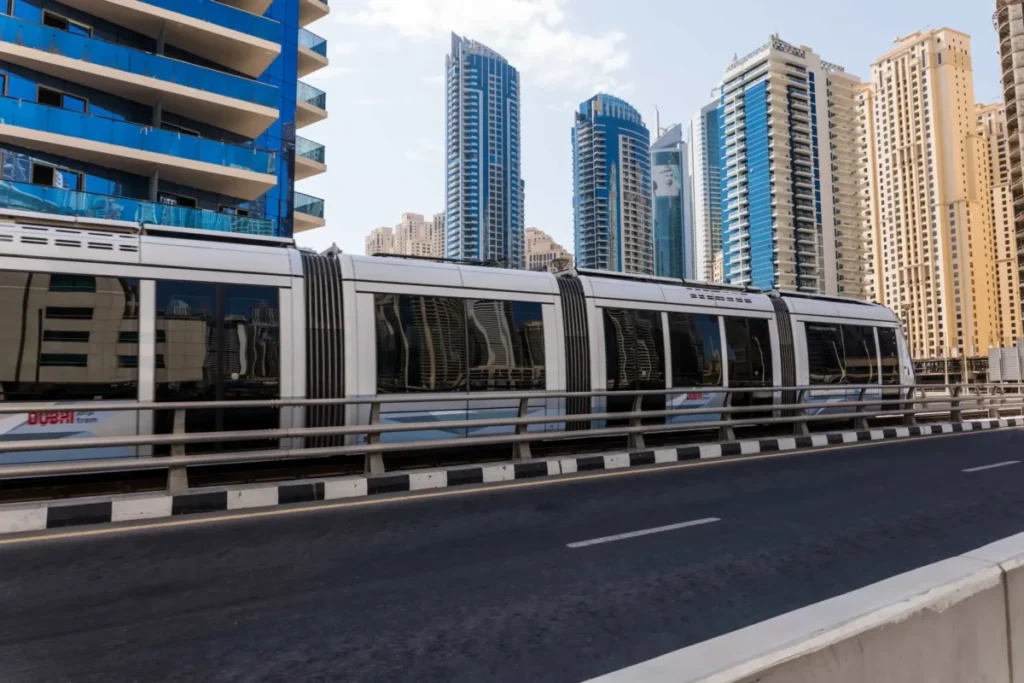
The Dubai Tram runs a 10.6 km route with 11 stations along Al Sufouh Road, connecting Jumeirah Beach Residence to Dubai Internet City. It connects to the Red Line Metro at DAMAC Properties station (for Dubai Marina) and at Dubai Internet City station. It also links to the Palm Jumeirah monorail at Palm Jumeirah station.
Frequency is 10 to 14 minutes during standard operating hours: 06:30 to 01:00 on weekdays, 09:00 to 01:00 on Saturdays and Sundays. Fares use the Nol card at the same zone-based rate as the Metro.
Its practical use case is narrow but specific: getting between JBR, Dubai Marina, JBR Walk, Media City, and Internet City without a taxi. For anyone working in the tech or media cluster and living in Marina or JBR, it removes the need for a car entirely in that catchment.
Water Transport: Abras, Water Buses, and Water Taxis
Dubai Creek carries an abra service that has operated in roughly the same form since the 1960s. Abra fares are AED 1 per crossing between Bur Dubai and Deira. The crossing takes approximately seven minutes. No Nol card required. Departure is continuous during daylight hours, with boats leaving as they fill (typically 20 passengers).
The RTA Water Bus service connects 13 stations along Dubai Creek and the Dubai Water Canal, from Al Jadaf to Al Seef, with an extension to Business Bay and Dubai Canal. Fares range from AED 4 to AED 5.50 depending on distance. Air-conditioned cabins. Runs 08:00 to 22:00 on weekdays, with reduced weekend schedules.
Water taxis offer on-demand, point-to-point service for groups. Bookable via the Dubai Ferry app. Starting fares are around AED 100 for short charters, depending on the route and number of passengers.
The ferry service from Dubai Marina to Dubai Canal (Al Wasl) is a fixed-route service, operating three times daily in each direction, useful mainly for tourists or waterfront residents with flexible schedules.
Taxis and Ride-Hailing: The Gap-Fillers
RTA-regulated taxis and app-based ride-hailing (Careem, Uber, Hala) are the dominant choice for any journey not well-served by rail or bus. Starting flag fare for taxis is AED 5 for standard and AED 4 for taxis hailed from the street. Per-kilometre rate is AED 1.96 after the initial distance.
Airport surcharges apply: a fixed AED 25 surcharge is added to all trips originating from Dubai International Airport. Friday to Sunday late-night fares (01:00 to 06:00) carry an AED 2 supplement.
Hala is the RTA’s official ride-hailing integration in Careem. It dispatches licensed RTA cabs through the app with upfront pricing and no surge pricing caps. Careem and Uber operate alongside Hala but are privately metered, meaning surge pricing applies during peak demand.
In practice, taxis and ride-hailing are the right choice when your destination is in a Metro gap zone, you are carrying luggage, you are travelling with more than three people, or the time cost of a multi-modal trip exceeds the fare difference. They are not, however, cost-viable for the daily Dubai to Abu Dhabi run, where a single one-way metered fare typically lands between AED 200 and AED 300.
Personal Vehicles: Full Flexibility, Real Cost Overhead
Driving in Dubai is straightforward by regional standards. Roads are wide, well-signposted in Arabic and English, and maintained to a high standard. Petrol prices are set monthly by the UAE Fuel Price Committee. As of early 2026, Special 95 sits at approximately AED 2.67 per litre.
Salik, Dubai’s electronic toll system, charges AED 4 per gate crossing. Eight Salik gates operate across the city as of 2025, including on Al Maktoum Bridge, Garhoud Bridge, the tunnel connecting Bur Dubai to Deira, and the Al Safa and Al Barsha points on Sheikh Zayed Road. Heavy commuters crossing multiple gates daily can accumulate AED 30 to 40 in daily toll costs within Dubai alone.
Parking in central zones (Downtown, DIFC, Business Bay) is paid via RTA Mawaqif: AED 3 to 7 per hour depending on zone colour classification. Free parking is available in outer residential areas and most malls, but mall parking in central areas is increasingly subject to paid zones during peak retail hours.
For commuters travelling exclusively within Dubai, a personal vehicle makes financial sense only when your route has genuinely poor public transport coverage and your working hours do not align with Metro operating windows. For the Dubai to Abu Dhabi corridor, the calculus shifts further: you add approximately 140 km to your daily odometer, E11 fuel consumption for a midsize saloon is roughly AED 30 to 35 per one-way trip, and Abu Dhabi parking in commercial zones costs AED 2 to 4 per hour. The monthly overhead adds up well above what a dedicated car lift seat arrangement costs.
Dubai to Abu Dhabi: The Case for a Dedicated Car Lift Service
The 140 km intercity connection between Dubai and Abu Dhabi sits outside the RTA framework entirely. No Metro, tram, or standard urban bus line connects the two cities for daily commuters. The formal options are: intercity bus (E100 from Abu Dhabi Central Bus Terminal to Union Square in Dubai), personal vehicle, metered taxi, or a dedicated car lift service.
The E100 intercity bus operates from 05:00 to 23:00 at 30-minute intervals for AED 25 per journey. Journey time is 1 hour 45 minutes to 2 hours depending on traffic at the Abu Dhabi side toll point. It is the cheapest option but the least flexible: terminal-to-terminal, no door proximity, no schedule alignment with shift start times.
A metered taxi for the full route typically costs AED 200 to 300 one way. At five days a week each direction, that is AED 2,000 to 3,000 per week in taxi fares alone, a number that rules it out for regular commuters without an employer subsidy.
This is the gap that car lift services were built for. MB Car Lift operates daily Dubai to Abu Dhabi routes, running scheduled shared-seat trips with professional drivers, well-maintained vehicles, and fixed per-seat pricing that makes daily cross-emirate commuting financially viable.
A car lift seat on the Dubai to Abu Dhabi route is typically priced at AED 35 to 50 per direction. On a standard five-day working week, that is AED 350 to 500 per week round-trip, or roughly AED 1,500 to 2,000 per month. Compare that against personal vehicle costs (fuel, Salik, depreciation, parking) or the taxi rate, and the monthly saving sits between AED 1,500 and AED 3,500 depending on your baseline.
MB Car Lift’s monthly commuter packages are structured specifically around this calculation, with fixed-route bookings for professionals and families who need schedule consistency across the working week. Pickup and drop-off are coordinated to your actual origin and destination, not just the nearest bus terminal, and departure times are aligned to standard office hours rather than a fixed timetable.
For anyone working in Abu Dhabi while based in Dubai, or for families with one member commuting in each direction, a monthly car lift arrangement removes the two largest variables in cross-emirate commuting: unpredictable cost and terminal dependency.
Side-by-Side: Mode Selection by Journey Type
| Journey Type | Best Primary Mode | Notes |
|---|---|---|
| Airport to Downtown | Metro Red Line | AED 5-7.50, no traffic exposure |
| JBR to Media City | Dubai Tram | Direct, 12 min, AED 3 |
| Al Quoz to DIFC | Taxi or ride-hail | Metro gap zone |
| Deira Creek crossing | Abra | AED 1, fastest water option |
| Dubai to Abu Dhabi (daily commuter) | MB Car Lift | AED 35-50/seat, door-proximate pickup |
| Dubai to Abu Dhabi (occasional trip) | Intercity bus E100 | AED 25, terminal-based |
| Outer suburb to Metro station | Bus then Metro | Nol card, allow 15-min wait at stop |
| Late night anywhere in Dubai | Taxi or Hala | Metro closes at midnight |
The Practical Answer
No single mode covers all of Dubai. Residents who move most efficiently use the Metro as the primary rail spine, supplement with bus or tram for the last mile, and use taxis or ride-hailing for Metro gap zones and off-hours travel. Personal vehicles are the default for outer residential areas with poor public transport density, but carry daily costs that well-planned public transport combinations avoid.
For the Dubai to Abu Dhabi corridor, the practical answer is a dedicated car lift. The intercity bus covers the occasional trip. A metered taxi covers the urgent one-off. Neither is designed around the five-day working week of a cross-emirate professional. A structured monthly arrangement through MB Car Lift is the only option that combines commuter-level cost, flexible pickup, and schedule coordination for that specific journey.
MB Car Lift operates daily Dubai to Abu Dhabi car lift and pick and drop services, including monthly commuter packages for professionals and families. Contact us on +971 58 589 8074 to arrange your route.